Hi everyone! Here’s another quick update:
1. First of all, please join me in congratulating Jaye Milius, author of the crazy cool "Terminus," on achieving Quill status! To me, this is what Inkshares is all about, outstanding new authors able to showcase their work, crowdfunding readers like us confirming its value with our pre-orders, resulting in a publication deal by a real publishing company. Really, how awesome is that! - A huge congrats, Jaye, on a completely well-deserved achievement!
2. On a more egotistical note, I noticed Inkshares has me listed as the "#98 Most Influential Reader!" Ha! Who knows how that works! I guess I’ll just keep being who I am and doing what I do, and we’ll see how high that will go! :-)
3. Chris Pyke and I are in the last stages of finalizing another cool illustration. We went back to one of Mission 51’s earlier chapters, "The Press Conference," and picked out not one but two essential moments in that short scene. We’ll present them in a two-pane, comic-book style illustration. I’m pretty excited about that!
4. Mission 51 will continue in draft mode while it is entered in the Launch Pad Manuscript Competition. The competition is now closed, and we are waiting on judging, etc. I have no idea how many people have entered, but I’m sure the competition is fierce. At the very least, I will get comprehensive feedback from a panel of judges who are all important players in the entertainment industry. That’s sure to be valuable. But please, cross fingers and toes for me that Mission 51 is well-received and at least makes the first cut in late September.
5. Last but certainly not least, I extend a very warm welcome to all the new Mission 51 followers. I am truly grateful that you are part of our fantastic family of mutually supportive authors and readers!
Peace and love, y’all! :-)
A HUGE thank you to everyone following and supporting Ward of the South. It’s a heady and nerve-wracking feeling to put your work up, as many here on Inkshares before me would know.
Whether it does well in the competition, reaches publication level or not - and at the risk of using cheesy cliches - I already feel like a winner.
Here’s to the roller-coaster to come!
Cheers everyone.
Cem
Readers,
I wanted to share something very exciting with you!
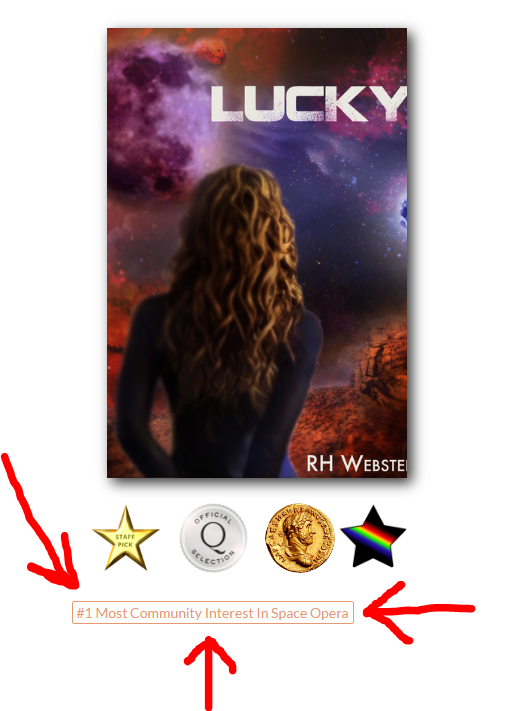
(That’s the extent of my Photoshop skills, sorry.)
See those red arrows? Those arrows are pointing to the #1 Most Community Interest in Space Opera. That’s our Lucky, right there, sitting at the top of the pile. And that’s all because of you, the readers. Take a moment today to treat yourself to an extra cup of coffee, a donut, or something special. You’ve made a difference in the life of an author and the luck (no puns, I swear) of a novel.
Thank you all so much for your continued support.
- Webster

Audacity is all and more than need for a reading - if you want to take a look at Reaper it’s great, too, (as is QBase or ProTools) but Audacity is the simplest of all and truly all you need - we’re talking single track recording after all :)
I would strongly suggest that you invest in a separate microphone and not use a mic built in to a video camera (whether it’s built in to your laptop or tablet or a usb camera) - for a couple of reasons:
First: those mics will pick up all sorts of extraneous sound that will distract from your reading
Second: you’ll need to use the advice @Luke Fellner gave re: speaking loudly and projecting from the diaphragm - wonderful advice for a distant microphone and a stage actor but better not to need when reading something as intimate as a book chapter. Remember, what you’re doing is reading to a person, you want to encourage them to close their eyes and visualise the story, so you want to be able to adjust your dynamics according to the emotion of the passage or dialogue, you don’t want to have to shout all the time... but I’ll get to performance next.
Note: I have the VidPro one and it has a 20 FOOT cord so when I’m in the mood for using my dictation software I can actually get a good pace around the room going!
If you’re up for a bit more expense in the form of an audio interface and so can use a mic with an analogue cable, the combo of the Focusrite Scarlett 2i2 interface with a Shure SM-58 is a popular one. I personally use that baby Scarlett with a Rode Procaster.
(Note: There are condenser USB mics that are popular (like the Yeti series) but condenser mics should really only be used in either a beautifully sound proofed room and/or if you are a musician who will be playing so loud that you can have your gain waaaay down. If you’re just a spoken voice reading into a Yeti (or chatting on a podcast) your audience will hear the neighbour three streets away call their dog in to dinner! )
Here are my top pieces of advice:
1) Don’t worry if you don’t have the skill to do accents or character voices. If you do (and they’re really good) great but remember you are not auditioning for a part as an actor or even as an audio book narrator, you are the author of the piece presenting the text that you are hoping they will like enough to buy and read for themselves. They won’t have you reading to them with a Welsh accent to tell them which character is speaking when they read your text - if a plain reading of the text is confusing, then edit your dialogue tags to make it clear (reading out loud is a GREAT editing tool.) Expressing the emotion in your words is more important than an accent or change in tone
3) Do Enunciate, but not so much that it’s unnatural or changes your accent. Aim for being a clearer you. When it comes to the hard consonants, though – you might have to soften them a little, especially Ts, Ds and Ss because some people are simply more sibilant than others (it’s the shape of the teeth!) so, again, have a little practice and try different mic placements if you’re finding that your ears get blown out by those sounds when you play them back.
Similarly plosives (Ps, Bs) can be an issue with puffing on the microphone causing a ‘pop’ to be recorded. This can be helped with a pop-shield and mic placement but some level of technique (which I haven’t mastered yet) is often still required (though lavalier mics are a great way to avoid much of this!)
5) Try to relax, trust your story and get into the action and the characters. If you’re enjoying it, your readers most likely will, too. Remember, it’s an author podcast that doesn’t need to be perfect, it’s not an audiobook for sale
You can hear my attempts at reading the first 9 chapters of The War of Wind & Moon in the video section of its page. (Also on Soundcloud and as a podcast on iTunes if you’re so inclined just search for Wind and Moon or Darcy Conroy.)