Charles Moore followed Thomas J. Arnold
Thomas J. Arnold
A bumbling madman in an unholy relationship with the written language. Author of Exile, Magus; Exi...
Follow
Thomas J. Arnold liked an update for Disintegration

One thing that’s always bugged me about science fiction is the Christian calendar. Sticking with it has made many things either laughably too soon or absurdly too far away. 

Hoverboards and flying cars in Back to the Future’s 2015. We’re past that moment, and we have neither (at least, not available to the mass market).

Blade Runner is three years away ... Roy Batty is not being made anytime soon.

Anything set in the 3000s seems too far afield of now to even speculate about. In fact, putting a fixed date relative to the present is the one of the biggest disservices a sci-fi author can do to their story. The one case where fixed dates don’t rankle me is in stories that extrapolate contemporary culture to a reasonable degree, set in the near future.

My way around this fixed-date problem was to abolish the Christian calendar. I took particular delight in this; I think the moment humanity abandons organized religion (not spirituality, just dogmatic faith) will be a watershed event that heralds unprecedented personal growth and special (as in species) progress. I am not personally an atheist, but I am a big fan of Richard Dawkins and Christopher Hitchens, and I would prefer that all of the evangelical hucksters of the world would simply wink out of existence and stop grifting their flocks.

The events of Disintegration take place 183 years Post Blight (check out my draft idea, The Blight, by the way). When was The Blight? Sometime in the future of a mirror Earth whose present is very much like ours, but I never picked a specific date.

In the story Integration, which takes place before The Blight, the Christian calendar has already been abolished. The Earth I write about is mostly free from the handicaps of dogma, puritanism and shame-culture. Judaism, Christianity and Islam have all become cults on the fringes of society, practiced by a dwindling core of zealots, marginalized by a majority comprising pantheist, agnostic and atheists. The less overtly destructive faiths are also still practiced, but their followings are also small and, since their practitioners are inclined to neither violence nor proselytizing, they have no pejorative impact upon mainstream society. Such faiths are actually coexist quite harmoniously with the irreligious society because a mutual respect exists wherein neither side is attempting to sway the other. In this era, humanity adopted a new calendar commemorating the moment where a minimum standard of living was provided to every human being on the planet.

Of course, there needs to be a date where the Christian calendar ends and the Global Socialist calendar begins, but I’m not going to ascribe a specific moment in time to that transition. I’ve always been a bigger fan of "sometime in the future" or "a long time ago" than 2001. Arthur C. Clarke is one of my heroes and, as I mentioned in my video, I can only aspire to his prescience, but he (and others) taught me a valuable lesson about speculating: don’t be specific about the when.

Today is the last day to pre-order Disintegration. If you’ve been waiting for that last-ditch moment, it’s arrived. Maximal tension achieved. Please stop biting your nails and, instead, twiddle your fingers over your mouse and keyboard, or your handheld computing portal to the virtual world, and -- at least -- get me to (giddy up) 409. ;)

like · liked by Thomas and 3 others

People who have liked this reader update

    Thomas J. Arnold followed Sam Died Today
    Sam Died Today
    Sam dies. His friends and family mourn. But not everyone’s sad. Some of them know Sam more than anyone. And not everyone’s nice.
    Thomas J. Arnold followed J.N. Jones
    J.N. Jones
    Dedicated sci-fi lover and writer!
    Follow
    Thomas J. Arnold liked the forum thread, Large Accounts leaving Inkshares
    I don’t know that the three month window is true. I’m still in that window for The Life Engineered and while heavy promotional efforts have died down after launch I don’t think that, as long as the book is on their platform, Inkshares will ever really stop pushing the book. Keep in mind that they don’t need to sell that many copies of a book before they gather the financial benefits of a paid service the likes of which you describe.

    Also, this opens the door to writers complaining about paying for a service but being dissatisfied when it doesn’t meet their expectations. I see this coming from writers who may not have a full understanding of how important their own involvement in promotion is, even after publication. 

    Bottom line: As long as the book is on Inkshares, they have a vested interest in that book selling copies, so I imagine that promotion will be a continuous effort regardless.

    like · liked by Elan and 6 others

    People who have liked this comment in the forum thread, Large Accounts leaving Inkshares

      Thomas J. Arnold liked the forum thread, Large Accounts leaving Inkshares
      Getting to know John and Zack well over their time in the community, I feel confidently they did not start a campaign just to collect email addresses, both ran great campaigns that for various reasons didn’t ultimately get them what they wanted for their career. I don’t think that is going to be an uncommon thing. I think it is safe to say we’ve all learned quite a bit in the Inkshares environment, and some people are going to decide it’s not a good fit for them. 

      Every reader they brought here could be a new reader for you. That sure sounds like an upside to me. They could be a new reader unless you did something like say, berate the author on his book page. Maybe next time someone bails on the site, send him/her a DM wish them luck and ask them if they’d push your book to their audience?
      like · liked by Zack and 2 others

      People who have liked this comment in the forum thread, Large Accounts leaving Inkshares

        Thomas J. Arnold liked the forum thread, Large Accounts leaving Inkshares
        Who cares? Inkshares has non-exclusive rights. The moment you are published, you can get picked up from different mediums. It doesn’t mean you won’t be fond of Inkshares or even still have an Inkshares imprint on your novel. 

        Some authors are going to toss their hats in with Inkshares and use it for everything. Some are going to get their book printed by Inkshares, and then someone else, and then someone else, and so on, and so forth. 

        Good for both them!

        Crowd Funding isn’t for everyone. Furthermore: Any author can do what they want with their creative content. People can react to what the author did or did not do as well. 

        Inkshares is a platform. One that is getting better with each passing month, and is still a different kind of publisher. You won’t see large 20,000 initial print runs and traditional publishing here because that’s not their model. Inkshares can do more direct publisher to consumer sales and even act as a hub for rights distribution. 

        But if an author came to Inkshares, got published, and then another publishing house also wanted to print that book: It’s perfectly fine AND it’s right there in the terms of service. 

        So you can’t cry spilled milk just because someone else got an offer that may or may not be there. All you can do is be positive about your own work. 

        like · liked by Joseph and 5 others

        People who have liked this comment in the forum thread, Large Accounts leaving Inkshares

          Thomas J. Arnold liked the forum thread, Large Accounts leaving Inkshares
          Let me start by saying that I appreciate your pro-Inkshares stance. There is a lot to be gained by having authors in the community stand by each other and by the platform that Inkshares represents. I’ve been pretty vocal myself about the role I think Inkshares plays and will play in modern publishing and I clap my forearms together giggling with glee every time I’m proven right somehow.

          Be that as it may, keeping in mind that I agree with the spirit of what you say, I think you need to ratchet it back a little. Not saying it to contradict you but rather to assuage your wrath and smooth your anger. Writing books is stressful enough, you don’t need that kind of emotion in your life. 

          So let’s unwrap this a little, shall we?

          First, let’s look at whether or not these authors, or any writer that builds a following and leaves, are doing any harm to Inkshares. I’m going to say that the final word should be from Jeremy or Avalon or Matt, maybe even Adam! Probably not Thaddeus though. I like to think they keep him too busy for that. But in my opinion there is no harm. When a writer leaves Inkshares and takes a mailing list with him/her/it (robots!) it’s not a zero-sum situation. Inkshares retains those names too and more importantly, so do all the other authors who have these readers as followers too. While there is some degree of promotional and administrative investment that is lost, the readers these vile deserters have brought are still a benefit to Inkshares and other writers.

          Second, leaving hurts these authors more than it hurts anyone else. Here’s why: Assuming they aren’t leaving because they were approached by an agent or a publisher, then that means they’re heading towards self publishing. I’ve self published. Pardon my french but Fuck. That. Shit. Sideways. With a crowbar. As much as I hate promoting a funding campaign (and oooh how I loathe it...) self publishing is that on steroids (TM Dan Carlin). It’s self promotion + investment + inventory management + distribution management + production management + no cookies. Ever. It’s the worst. But the real problem with abandoning an Inkshares campaign and running into the night with reader emails like the Hamburglar with a bag full of Happy Meals, is that there is no guarantee that everyone who pre-ordered the book on Inkshares is going to do so again on another platform. Especially those who paid with credits. And people who were following a book but hadn’t ordered it are even less likely to jump all over the self published version of that. So worry not my friend, if they ran to self publish I can all but guarantee some greek mythology level comeuppance to them. Real ironic stuff there.

          Now, if they are going away because they were poached by an agent or publisher, well, to be honest, that’s an opportunity that I feel even Inkshares will agree they’d be stupid not to take. Maybe if they had funded at the full 750 pre order level it becomes more of a grey area, but the Quill goal vs. traditional representation by a publisher? I’ll take the later. Sorry Inkshares. So I can’t exactly blame them. But, since as we’ve seen they’re not hurting the platform that much to begin with, I don’t think it’s too big a deal.

          Now, here’s where taking action to nip this in the bud is a touchy subject. I agree that an eye has to be kept on other publishers coming in to steal promising projects before they get funded. If Inkshares becomes a marketplace not for readers but for traditional publishers to shop around for talent, then it could potentially harm the platform that stands to revolutionize publishing as we know it(!).

          But we have to be careful... this is where my experience in marketing becomes valuable. Check it out:

          There’s this old saying: "Don’t cut your nose off just to spite your face". It’s not the best saying but it does illustrate a problem that some companies have where they will harm their target users just to deny abusers. That ain’t cool. That’s the kind of behaviour that makes it so we can’t have nice things. Allow me to illustrate with a personal example.

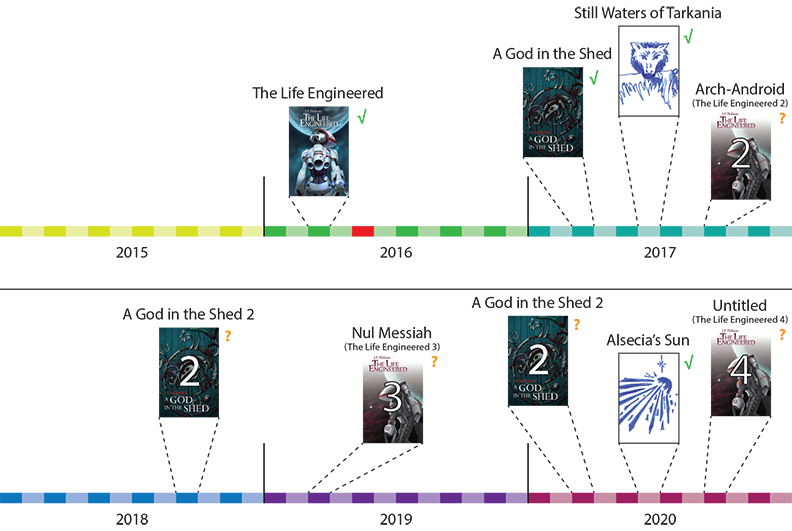
          This is my projected book schedule for the next few years:

          Notice the two books with really crude artwork instead of covers? The ones that look like napkin scribbles? Those aren’t going to be published on Inkshares. These are books I’m contracted to write for the awesome Ed Greenwood Group. Now, I’m going to assume that people who buy The Life Engineered (available on Amazon!) and A God in the Shed (not available yet! Pre-order now!) are going to be, to various degrees, fan of my work. I want to tell them about those non-Inkshares books and they want to hear about those non-Inkshares books. And I want to do it through another means of communication than the Inkshares updates for my current projects. I.e.: I need those email lists. Those lists are more useful to me (and Inkshares by association) than they are harmful in the hands of the Vile Deserters. If Inkshares removes access to those, they are harming me. They are limiting my access to my reader base. They are making my experience on Inkshares less pleasant and profitable. I get less value from it. All in the name of stopping the Vile Deserters.

          The point of that, and it’s only one example of how this can impede the ’good’ users, is that we have to be careful what we do just to protect ourselves from the potential and perhaps inconsequential threat of the ’bad’ users. Another example you demand? By all means! What if there’s an AMAZING author that is contemplating the platform in a few months and his book would be a NYT best seller. Just, the biggest thing. But what if it could go two ways; he jumps in and his book put Inkshares on the map so hard that they become the next RandomPenguinHouse OR he looks at the policies in place to limit abuse and decides it’s too restrictive and goes elsewhere. I mean, yay, we’ve kept the ’bad’ people out, but we’ve also shot ourselves in the foot.

          There are going to be people who are going to be dissatisfied with Inkshares. Or they’re going to find that the platform doesn’t suit them. Or they’re going to get a better offer somewhere else. Some will leave peacefully and some won’t. It’s gonna suck sometimes and we’re going to be angry for a few and happy for others, depending on context, but we can’t afford to let that affect the direction and goal of the platform.

          The takeaway for me is: don’t get mad about these guys. They’re not your problem and they haven’t harmed you in any significant way and they’re not hurting Inkshares, but please don’t advocate too hard for a tightening of the policies because I’m worried it’ll do more harm than good.

          Meanwhile, I’ll be extracting my email lists while I still can!
          like · liked by Nicola and 11 others

          People who have liked this comment in the forum thread, Large Accounts leaving Inkshares

            Thomas J. Arnold liked the forum thread, Large Accounts leaving Inkshares
            This seems to be concern about goldmining on Inkshares and the nefarious intentions of certain authors to manipulate the platform for their gain. Before I weigh in on the topic regarding those accused of it at the moment, I will say this practice is nothing new to crowdfunding, and has yet to sink any businesses (that I know of).

            Inkshares is a forward thinking company. I used to be concerned about their future because much of what we do is insular -- authors come to the site to publish their book, we bring our small audiences and connect with the user base here to promote our projects, the vast majority of which are also authors looking to publish. The percentage of projects funded through legitimate reader fan base versus those funded by other authors -- that used to worry me. After all we’re not only trying to publish a book here, we’re trying to build a genuine readership, and flooding a project with preorder trades will eventually backfire because of a lack of reader conversion. It’s not like someone who buys 10 copies of my book will send those ebooks out to 10 readers.  They are essentially empty numbers.

            But as I said, Inkshares is concerned with the innovating the future. They wanted to innovate the book publishing industry by providing an avenue for indie authors to use their promotion skills up front to get their books made. Now they are revolutionizing the licensing of books in their roster and building a pipeline to make it easy for great stories to have their rights sold for audiobooks, movies, and foreign language adaptations. All of this is forward thinking and forward moving. It’s very Walt Disney of them.

            Back to the manipulation allegations. Knowing that Inkshares is a forward momentum organization, I can’t see how a handful of people leaving the site is going to crash the company -- and that is regardless of whether or not the people in question really are goldfarming (Their intent actually doesn’t matter to this discussion).  Again, the majority of people in an Inkshares book reader base are authors already on the site. That is across the board, with the exception of some who brought their audiences to Inkshares and funded with ease.  Those readers are also funding books on the site. They aren’t going anywhere because they are invested in this platform. 

            I have seen an additional concern that people in the contests that don’t win will start leaving the site because of the few outliers that are (theoretically) intentionally goldfarming email lists.  Again, I don’t see this being the case. People who lose the contests fall into two groups: People that leave and people that stay. This has been the case since the first Sword & Laser contest. Many of us fail and stay, many fail and leave. The site has grown exponentially throughout, regardless of this ebb and flow.

            I see a level of righteous indignation here directed at a couple of authors who have made choices about their projects, choices that really don’t affect us as authors on the site. Inkshares is building partnerships with strong geeky companies and will continue to flourish by establishing themselves as the leading name in hybrid publishing. If two writers or ten or fifty take their books off site and take their email lists with them, then that’s a selection of people who are now familiar with the Inkshares model, who are already connected to the site, and who take that knowledge with them. If one of those books who leave the site become huge, that indirectly HELPS Inkshares because their story began here and that helps with brand saturation.

            I am by no means a sunshine and roses person. Ask anyone who knows me, I tend to side the the cynical on any given conversation. But this one just doesn’t hold water.  Even if the writers in question are mining the site for users, which I don’t think they actually are, that is not harmful to the business model of the site as it spreads brand recognition for Inkshares, and Inkshares is continually innovating so any theoretical harm done to the current phase of the company could not possibly work against them in their other endeavors.
            like · liked by Yekaterina and 4 others

            People who have liked this comment in the forum thread, Large Accounts leaving Inkshares

              Thomas J. Arnold liked the forum thread, Large Accounts leaving Inkshares
              This seems to be concern about goldmining on Inkshares and the nefarious intentions of certain authors to manipulate the platform for their gain. Before I weigh in on the topic regarding those accused of it at the moment, I will say this practice is nothing new to crowdfunding, and has yet to sink any businesses (that I know of).

              Inkshares is a forward thinking company. I used to be concerned about their future because much of what we do is insular -- authors come to the site to publish their book, we bring our small audiences and connect with the user base here to promote our projects, the vast majority of which are also authors looking to publish. The percentage of projects funded through legitimate reader fan base versus those funded by other authors -- that used to worry me. After all we’re not only trying to publish a book here, we’re trying to build a genuine readership, and flooding a project with preorder trades will eventually backfire because of a lack of reader conversion. It’s not like someone who buys 10 copies of my book will send those ebooks out to 10 readers.  They are essentially empty numbers.

              But as I said, Inkshares is concerned with the innovating the future. They wanted to innovate the book publishing industry by providing an avenue for indie authors to use their promotion skills up front to get their books made. Now they are revolutionizing the licensing of books in their roster and building a pipeline to make it easy for great stories to have their rights sold for audiobooks, movies, and foreign language adaptations. All of this is forward thinking and forward moving. It’s very Walt Disney of them.

              Back to the manipulation allegations. Knowing that Inkshares is a forward momentum organization, I can’t see how a handful of people leaving the site is going to crash the company -- and that is regardless of whether or not the people in question really are goldfarming (Their intent actually doesn’t matter to this discussion).  Again, the majority of people in an Inkshares book reader base are authors already on the site. That is across the board, with the exception of some who brought their audiences to Inkshares and funded with ease.  Those readers are also funding books on the site. They aren’t going anywhere because they are invested in this platform. 

              I have seen an additional concern that people in the contests that don’t win will start leaving the site because of the few outliers that are (theoretically) intentionally goldfarming email lists.  Again, I don’t see this being the case. People who lose the contests fall into two groups: People that leave and people that stay. This has been the case since the first Sword & Laser contest. Many of us fail and stay, many fail and leave. The site has grown exponentially throughout, regardless of this ebb and flow.

              I see a level of righteous indignation here directed at a couple of authors who have made choices about their projects, choices that really don’t affect us as authors on the site. Inkshares is building partnerships with strong geeky companies and will continue to flourish by establishing themselves as the leading name in hybrid publishing. If two writers or ten or fifty take their books off site and take their email lists with them, then that’s a selection of people who are now familiar with the Inkshares model, who are already connected to the site, and who take that knowledge with them. If one of those books who leave the site become huge, that indirectly HELPS Inkshares because their story began here and that helps with brand saturation.

              I am by no means a sunshine and roses person. Ask anyone who knows me, I tend to side the the cynical on any given conversation. But this one just doesn’t hold water.  Even if the writers in question are mining the site for users, which I don’t think they actually are, that is not harmful to the business model of the site as it spreads brand recognition for Inkshares, and Inkshares is continually innovating so any theoretical harm done to the current phase of the company could not possibly work against them in their other endeavors.
              like · liked by Yekaterina and 4 others

              People who have liked this comment in the forum thread, Large Accounts leaving Inkshares

                More items