
Matthew Isaac Sobin liked an update for Murder at the Veterans’ Club

Dear friends and followers,

As I write this, we are at 303 pre-orders. Wow. I was sitting here yesterday morning, thinking, "oh, would it not be cool if we could clear 300 tonight?" And here we are. 303. You know what this means?

It means we now get to gaze across the desolate plains of 300-400 and despair.

Okay, sort of but not really. Clearing 300 is crossing a psychological barrier. It puts the end goal of 750 that much closer, and makes it look that much more attainable. It’s that first digit that makes the difference. We can do this, people. I believe this in a way I didn’t back when we were at 299, and I have you all to thank for it. (The image in the header above is from Jacques-Louis David’s "Leonidas at Thermopylae", because everyone knows "300" equates to "Spartan Awesomeness".)

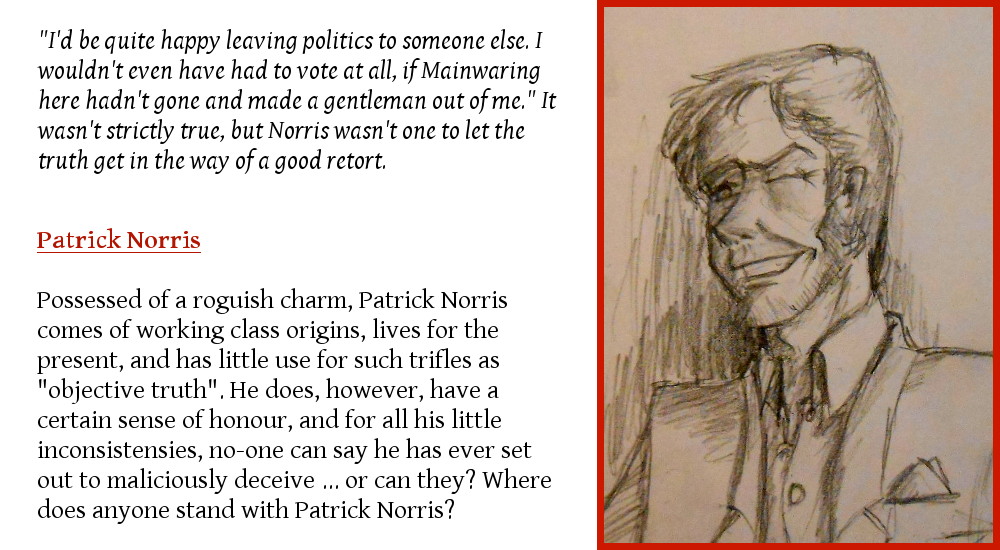
So ... how about a look at another of the characters you’ll be meeting in this book? Introducing Patrick Norris:
And here’s our weekly look around the bookshelves on Inkshares:

1) "Upload", by Mark Meredith. In a world where people clone themselves in case of death, a New York cop has to solve his own murder. I just came across this today, and it looks SO GOOD. The writing has a deliciously gruff, cynical tone, the sort you might expect in a noir thriller--so I’m jolly well going to read it as one.

2) "Patria", by Robert Groves. A Mexican immigrant to the UK and his adventures with Mexican cuisine. I love food, and I love a story where food makes things better. And anyone who loves Mexican cuisine as much as Groves does (check out his MexiGeek blog) is bound to come up with something suitably poetic.

3) "The Dead Wizard", by Brian Marsden. I’m not a fan of the title, but hey, these things may be changed in production. It’s about goblins investigating a murder ... I’m hoping for a bit of a Pratchett influence, and maybe some observed interaction between goblins and other fantasy races. Also, goblins can be so damnably cute when they’re just messing around.

Clearly, the way to impress me is to include in your premise the words "investigate a murder". Can you blame me, really? Until next time: keep having fun, and keep reading.

like · liked by Thomas and 9 others

People who have liked this reader update

    Matthew Isaac Sobin liked the forum thread, Large Accounts leaving Inkshares
    @Jeremy Thomas and team, the properties/rights addition is GENIUS. For everyone else, I can’t stress enough how valuable that will be for a book that gets listed here , because at least from the movie and TV side of things, they are constantly looking for new properties to acquire and this hands it to them on a silver platter for their perusal.

    like · liked by Brian and 4 others

    People who have liked this comment in the forum thread, Large Accounts leaving Inkshares

      Matthew Isaac Sobin liked an update for Jump the Gun

      Followers and readers, when the Geeks & Sundry contest ended, Jump the Gun had just made the jump to rank 11. Fantastic for a late entry.

      Now I need your help. I just released the third chapter, so it is a great time to review and recommend the novel, on Inkshares and everywhere else. Please do so! Word of mouth is vital for the success of the campaign!

      If you haven’t already, now is the time to pre-order. It’s a long way to go to 500 for this book to make Quill and be published. This novel is worth it.

      I’m also saving up for an art comission by the fabulous Dakota to raise the visibility of the project! Check out her work, she’s brilliant.

      Please pre-order, recommend and share. I need you!

      like · liked by Nicole.Serfling84 and 4 others

      People who have liked this reader update

        Matthew Isaac Sobin liked an update for The Punch Escrow

        Earlier this week, Geek & Sundry posted a very cool article about how Dungeons & Dragons was successfully being used in social therapy. In The Punch Escrow, I predict that games will replace therapy as we know it in the future.

        Here’s an excerpt from the chapter Hiraeth:

        In 1979 Edward Packard published the first commercially successful novel in what would become a very popular 20th century series of books called “Choose-Your-Own-Adventure.” In many ways this was a bridging of the worlds of interactive games and books (they didn’t have coms at the time, so they just wrote stuff down on paper), because the reader would play an active role in the narrative by choosing what the protagonist did next from a series of options. Rather delightfully, at least one option usually led to instant death.

        "The Cave of Time" was the title of the first adventure published in that series. It was an imaginative story that took its readers on a journey through several real and fictional periods of time, from the end of the entire universe to the days of Camelot and the round table. The story’s mechanism for time travel was rather brilliantly not some fantastic device invented by a Vernian mad professor, but rather a series of tunnels that transported the reader through time, depending on which tunnel they chose.

        Sometime in the early 22nd century, with the ubiquitousness of virtual reality and immersive gaming, a team comprised of cognitive neuroscientists and gaming technology experts created a psychoanalytical game based on The Cave Of Time. The virtual-reality game sought to help diagnose individuals with mental conditions, ideally with the aim of identifying such ailments before degeneration took effect. Using real-time analytics of eye movement, heart rate, neural activity, and facial expression, the games provided players with the opportunity to practice engaging in realistic social situations all in the context of a choose your own adventure scenario. The choices people made were helpful in establishing their mental state and whether they suffered from any psychological irregularities. The game itself eventually crossed over into the mainstream when modifications enabled players to edit content and endings. People would record their travels through the caves, personalizing outcomes. The caves became microcosms of their own universe and timelines.

        After the Last War, many attempted to play out alternate strategies and endings to the war in The Cave of Time. Eventually it became common wisdom that the Last War would have taken place regardless of what was done in the immediate years preceding it, the prevailing common wisdom was that the clockwork which led to the war’s advent was put into action thousands of years ago. Still, to this day people still try to go back in time through the caves in search of answers.  

        like · liked by Peter and 8 others

        People who have liked this reader update

          Matthew Isaac Sobin followed Paul Baumgarten
          Paul Baumgarten
          Follow
          Matthew Isaac Sobin followed Keith Powers
          Keith Powers
          Follow
          Matthew Isaac Sobin followed Matthew Gladwin
          Matthew Gladwin
          Science Fiction Author in the making. Realist by design, Optimist by choice. Quite possibly insane, ...
          Follow
          Matthew Isaac Sobin followed Shizuka Christine
          Shizuka Christine
          Follow
          Matthew Isaac Sobin followed Eliot Lyons
          Eliot Lyons
          Follow
          Matthew Isaac Sobin followed Marino Unger-Verna
          Dead Account
          Dead account.
          Follow
          More items