A bumbling madman in an unholy relationship with the written language. Author of Exile, Magus; Exi...

 I’m currently in the middle of a staycation here in the Orneck household. Movies, minimal cooking, discovering old restaurants made new...it’s heaven. It’s been great to get my creative juices flowing, so I am sitting down to sneak some planning in for Chapter 8, the big set piece.

Dear friends and followers,
As I write this, we are at 303 pre-orders. Wow. I was sitting here yesterday morning, thinking, "oh, would it not be cool if we could clear 300 tonight?" And here we are. 303. You know what this means?
It means we now get to gaze across the desolate plains of 300-400 and despair.
Okay, sort of but not really. Clearing 300 is crossing a psychological barrier. It puts the end goal of 750 that much closer, and makes it look that much more attainable. It’s that first digit that makes the difference. We can do this, people. I believe this in a way I didn’t back when we were at 299, and I have you all to thank for it. (The image in the header above is from Jacques-Louis David’s "Leonidas at Thermopylae", because everyone knows "300" equates to "Spartan Awesomeness".)
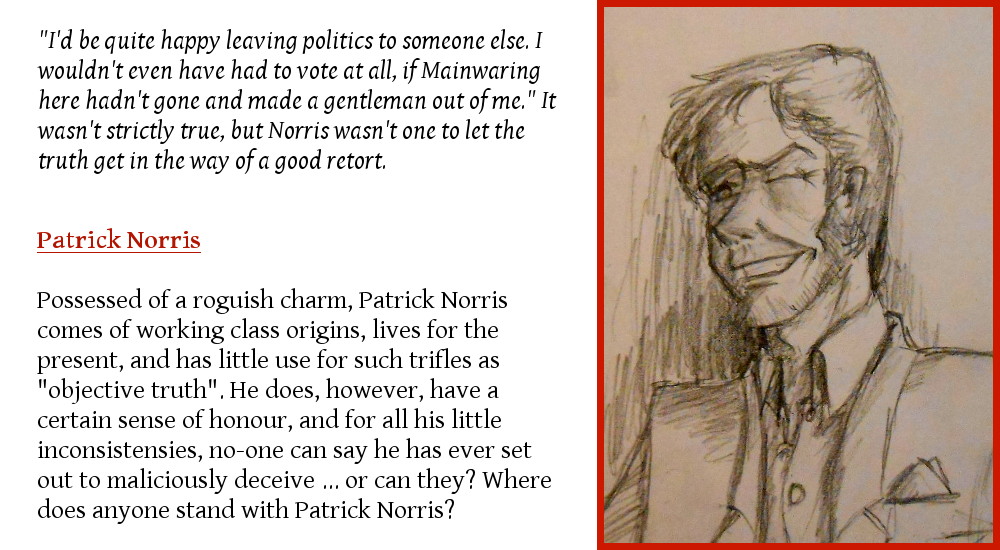
So ... how about a look at another of the characters you’ll be meeting in this book? Introducing Patrick Norris:
And here’s our weekly look around the bookshelves on Inkshares:
1) "Upload", by Mark Meredith. In a world where people clone themselves in case of death, a New York cop has to solve his own murder. I just came across this today, and it looks SO GOOD. The writing has a deliciously gruff, cynical tone, the sort you might expect in a noir thriller--so I’m jolly well going to read it as one.
2) "Patria", by Robert Groves. A Mexican immigrant to the UK and his adventures with Mexican cuisine. I love food, and I love a story where food makes things better. And anyone who loves Mexican cuisine as much as Groves does (check out his MexiGeek blog) is bound to come up with something suitably poetic.
3) "The Dead Wizard", by Brian Marsden. I’m not a fan of the title, but hey, these things may be changed in production. It’s about goblins investigating a murder ... I’m hoping for a bit of a Pratchett influence, and maybe some observed interaction between goblins and other fantasy races. Also, goblins can be so damnably cute when they’re just messing around.
Clearly, the way to impress me is to include in your premise the words "investigate a murder". Can you blame me, really? Until next time: keep having fun, and keep reading.
I bought a book. Now what?
This is the first update I’ve dispatched since These Are My Friends on Politics reached its full funding goal and became a real published book that a real publishing house is putting into real bookstores instead of the unprofitable ones I see in daydreams. So a thank you — to everyone who bought in, followed along, shared it with others and otherwise showed support for this little ray of light in this insatiable nightmare of an election year — is overdue.
But it’s overdue for a reason, because rather than thank and leave you with a vague "you’ll get it someday!," I wanted to show my gratitude by letting you know exactly what’s happening with your support. (And I wanted to know what I was talking about before I started talking.)
So here’s what’s happened. I sent in the manuscript and the initial cover design. Inkshares’ production partners at Girl Friday sent both back with some notes and some ideas about modestly bumping up the page count to hit the magic 64-page printing number (long story having to do with printers and multiples of four) and very possibly give the book the hardcover treatment (at no extra cost to you, of course) instead of the softcover treatment. (No promises yet on that, because I don’t know if it will happen, but it could happen.) I made a batch of new pages, lightly touched up a few existing pages, and handed in version 2. They sent back a few more notes, I did a last round of small touchups, and then I cropped and sized the pages so that they’re printer-perfect before handing in version 3.
And here’s what happens next. While the production wizards take those pages and assemble them into a sharp-looking book with all the interior and exterior necessities it needs, the marketing wizards at Inkshares are ramping up an extensive (word not used lightly — it’s extensive) plan to put the book inside national and independent bookstores and in front of media large and small that cover not just books, but politics and current events too. All of these wizards and plans are joining forces to coordinate a far-and-wide-reaching release in October, and if you’re a backer, you’ll have your signed and numbered copies of the book most likely a month before that October release date. (Again, that’s not ironclad, but based on what I’m told and on my own experiences as a backer of other authors’ books, backers getting their copies a month early seems to be the norm.)
So that’s the roadmap. It’s lengthy (even though it’s hyperloop-fast by book publishing standards — these things almost never happen inside of a year, never mind six months), but it’s that way because a lot of talented people are using really impressive resources to give this book the best possible chance it could ask for. When I said back in the campaigning stage that fully funding this thing is a (to borrow a phrase from the great Eddie Olczyk) tremendously tremendous deal, this is what I had in mind. So thank you for helping make that a reality.
5+2+1+1+6 = 15
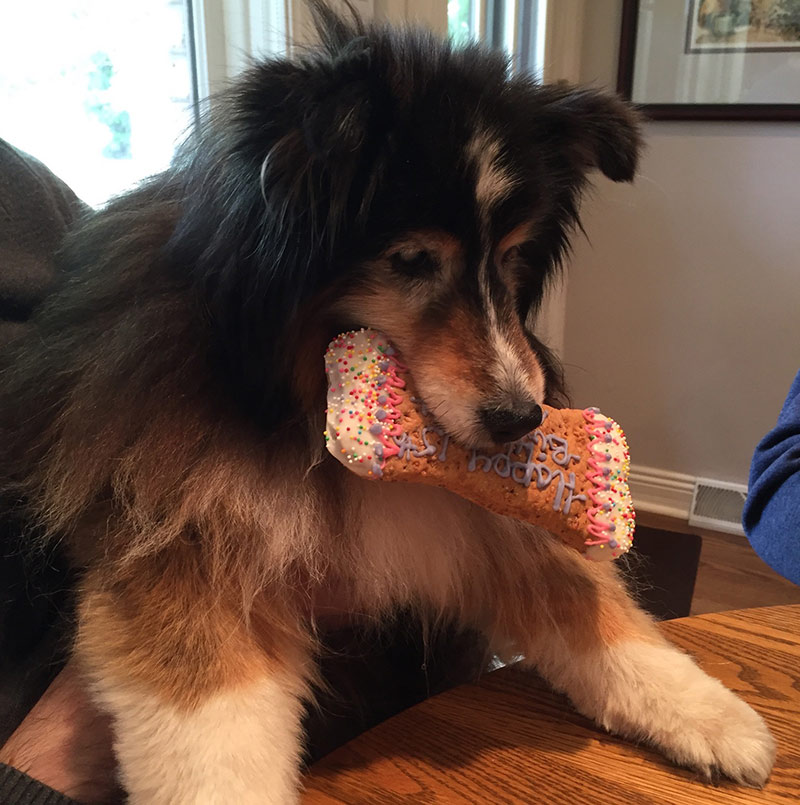
As is customary with these updates, I’ll close it out with the best thank you gift of all: some new pictures of Nina, who turned 15 on May 21 but whose face and table mannerisms remain indistinguishable from those of a puppy. Enjoy, and thank you again.