Let me start by saying that I appreciate your pro-Inkshares stance. There is a lot to be gained by having authors in the community stand by each other and by the platform that Inkshares represents. I’ve been pretty vocal myself about the role I think Inkshares plays and will play in modern publishing and I clap my forearms together giggling with glee every time I’m proven right somehow.
Be that as it may, keeping in mind that I agree with the spirit of what you say, I think you need to ratchet it back a little. Not saying it to contradict you but rather to assuage your wrath and smooth your anger. Writing books is stressful enough, you don’t need that kind of emotion in your life.
So let’s unwrap this a little, shall we?
First, let’s look at whether or not these authors, or any writer that builds a following and leaves, are doing any harm to Inkshares. I’m going to say that the final word should be from Jeremy or Avalon or Matt, maybe even Adam! Probably not Thaddeus though. I like to think they keep him too busy for that. But in my opinion there is no harm. When a writer leaves Inkshares and takes a mailing list with him/her/it (robots!) it’s not a zero-sum situation. Inkshares retains those names too and more importantly, so do all the other authors who have these readers as followers too. While there is some degree of promotional and administrative investment that is lost, the readers these vile deserters have brought are still a benefit to Inkshares and other writers.
Second, leaving hurts these authors more than it hurts anyone else. Here’s why: Assuming they aren’t leaving because they were approached by an agent or a publisher, then that means they’re heading towards self publishing. I’ve self published. Pardon my french but Fuck. That. Shit. Sideways. With a crowbar. As much as I hate promoting a funding campaign (and oooh how I loathe it...) self publishing is that on steroids (TM Dan Carlin). It’s self promotion + investment + inventory management + distribution management + production management + no cookies. Ever. It’s the worst. But the real problem with abandoning an Inkshares campaign and running into the night with reader emails like the Hamburglar with a bag full of Happy Meals, is that there is no guarantee that everyone who pre-ordered the book on Inkshares is going to do so again on another platform. Especially those who paid with credits. And people who were following a book but hadn’t ordered it are even less likely to jump all over the self published version of that. So worry not my friend, if they ran to self publish I can all but guarantee some greek mythology level comeuppance to them. Real ironic stuff there.
Now, if they are going away because they were poached by an agent or publisher, well, to be honest, that’s an opportunity that I feel even Inkshares will agree they’d be stupid not to take. Maybe if they had funded at the full 750 pre order level it becomes more of a grey area, but the Quill goal vs. traditional representation by a publisher? I’ll take the later. Sorry Inkshares. So I can’t exactly blame them. But, since as we’ve seen they’re not hurting the platform that much to begin with, I don’t think it’s too big a deal.
Now, here’s where taking action to nip this in the bud is a touchy subject. I agree that an eye has to be kept on other publishers coming in to steal promising projects before they get funded. If Inkshares becomes a marketplace not for readers but for traditional publishers to shop around for talent, then it could potentially harm the platform that stands to revolutionize publishing as we know it(!).
But we have to be careful... this is where my experience in marketing becomes valuable. Check it out:
There’s this old saying: "Don’t cut your nose off just to spite your face". It’s not the best saying but it does illustrate a problem that some companies have where they will harm their target users just to deny abusers. That ain’t cool. That’s the kind of behaviour that makes it so we can’t have nice things. Allow me to illustrate with a personal example.
This is my projected book schedule for the next few years:
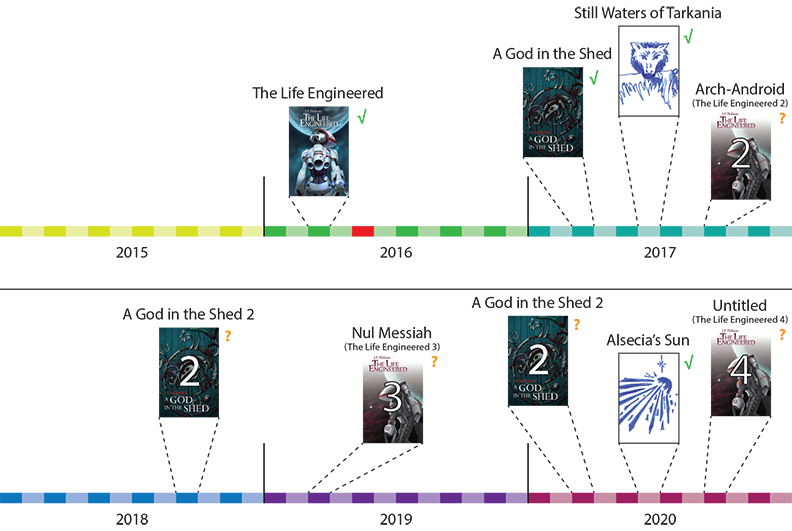
Notice the two books with really crude artwork instead of covers? The ones that look like napkin scribbles? Those aren’t going to be published on Inkshares. These are books I’m contracted to write for the awesome Ed Greenwood Group. Now, I’m going to assume that people who buy The Life Engineered (available on Amazon!) and A God in the Shed (not available yet! Pre-order now!) are going to be, to various degrees, fan of my work. I want to tell them about those non-Inkshares books and they want to hear about those non-Inkshares books. And I want to do it through another means of communication than the Inkshares updates for my current projects. I.e.: I need those email lists. Those lists are more useful to me (and Inkshares by association) than they are harmful in the hands of the Vile Deserters. If Inkshares removes access to those, they are harming me. They are limiting my access to my reader base. They are making my experience on Inkshares less pleasant and profitable. I get less value from it. All in the name of stopping the Vile Deserters.
The point of that, and it’s only one example of how this can impede the ’good’ users, is that we have to be careful what we do just to protect ourselves from the potential and perhaps inconsequential threat of the ’bad’ users. Another example you demand? By all means! What if there’s an AMAZING author that is contemplating the platform in a few months and his book would be a NYT best seller. Just, the biggest thing. But what if it could go two ways; he jumps in and his book put Inkshares on the map so hard that they become the next RandomPenguinHouse OR he looks at the policies in place to limit abuse and decides it’s too restrictive and goes elsewhere. I mean, yay, we’ve kept the ’bad’ people out, but we’ve also shot ourselves in the foot.
There are going to be people who are going to be dissatisfied with Inkshares. Or they’re going to find that the platform doesn’t suit them. Or they’re going to get a better offer somewhere else. Some will leave peacefully and some won’t. It’s gonna suck sometimes and we’re going to be angry for a few and happy for others, depending on context, but we can’t afford to let that affect the direction and goal of the platform.
The takeaway for me is: don’t get mad about these guys. They’re not your problem and they haven’t harmed you in any significant way and they’re not hurting Inkshares, but please don’t advocate too hard for a tightening of the policies because I’m worried it’ll do more harm than good.
Meanwhile, I’ll be extracting my email lists while I still can!


.JPG)

